Showing posts with label In the kitchen. Show all posts

Monday, June 9, 2014

Roast Your Own Coffee

I'm excited to present another guest author today!

Steve is an urban homesteader friend of mine and has tried something I thought was a great idea. Steve is roasting coffee in small batches for his own use.  Did you know you could do that? Roast coffee yourself? Honestly, the thought never occurred to me, but gosh, I'm excited to try it now!  

Here is the article he graciously wrote to describe his experience. Thank you, Steve!

                Not long ago at dinner the topic of coffee came up. It seems that due to the drought in South America we can expect coffee prices to rise as much as 25% some time in 2014. And we all know that once the prices rise on anything, rarely will we see them come back down to what we're used to. Add to that my favorite place to buy fresh roasted coffee decided to stop roasting in house and instead started having it shipped in. This got me to thinking about roasting my own coffee, I mean how hard can it be...right?

                The first commercial coffee roasting machine came out in the 1940's, that means every bean roasted up until then was done by hand. Out on a cattle drive over an open fire to the fanciest hotels they roasted by hand. So like everything I'm interested in, I started researching.  And truth told I found that there is no real mystery to roasting coffee, no double top secret recipes and no high priced equipment required. With a few necessities and some patience it's possible to roast fantastic coffee at home and for a fraction of the cost.

                First let's talk beans. Un-roasted coffee beans (actually they are seeds) 

 are pale-greenish in color. They are small, hard and there is a huge variety out there from every continent. Un-roasted or green coffee beans are cheap and can be stored for several months. You can find hundreds of places to buy green coffee beans online for prices that range anywhere from $5.00 per lb for Sumatra to as high as $15.00 per lb for Jamaican Blue. I found a local place here in Albuquerque that sells green coffee beans from all over the world for $6 per lb. You can find beans from all sorts of exotic places and you can buy directly from small farmers as opposed to buying from big business. The sky is the limit on what type of bean you roast, try beans from different continents and see how different they are.

 Next let's talk about roasting the beans. Understand there are all sorts of different ways people roast coffee, all you need is high even heat and a way to keep the beans moving. You can roast in a frying pan on the stove, in a hot air popcorn popper, a Wok,  in the oven and use a hot air gun. My first attempt was on the stove in a skillet. Seemed simple, you turn on the burner, pour in the beans and stirring like crazy. Let me stop here and give the guys a friendly warning. Before deciding you're going to roast coffee in your wife's skillet, on her stove and in her kitchen you may want to warn her ahead of time. Walking in on a smoke filled kitchen, smelling to high heaven with bits of chaff floating in the air....well let's just say I get myself in the darndest messes.

So...how did it come out? Actually not bad at all. What I did notice was how unevenly the beans roasted.

Some were very dark where others were a light tan. This was a result of two things, first my heat was too high and second I did not stir the beans often enough to get an even roast. This method would clearly take some time to get good at so I started looking at other options. After a good bit of consideration here's the method I settled on. 

The Whirley Pop popcorn popper! 

Remember those? It's the perfect set-up for roasting coffee. The pan is large, has a lid which helps with even heat and the wire rotating inside keeps the beans moving which results in a much more even roast

Some information on what's happening when you roast a coffee bean. The bean goes through several stages and color changes. One of the best explanations I have found is at the following link 

Sweet Maria's How to Get Started Roasting Coffee

Here's how I do it:

Turn on stove and get the Whirley Pop hot, you're looking for a temp of between 375 and 400 to start. You will notice in the pic I added a thermometer to the Whirley Pop. 

This is something you'll want to consider to help better manage the heat at first. After roasting several batches I roast now by sight and sound.

Once the Whirley Pop is good and hot, pour in the beans. I found 8 oz. to be a good amount to roast at one time and still get an even roast. Now Crank, Look and Listen!

The beans will begin to change color, turning yellow, then light tan and eventually depending on the roast very dark. Keep that handle cranking, as the beans get hotter the window of time between a good tasting roast and charcoal gets smaller and smaller.

Listen for what is known as the "First Crack", this is a distinct sound made by the bean as the internal temperature rises and causes the water and oils to escape. It will sound much like a kernel of corn popping, or maybe the sound of a toothpick snapping in two. And just like when you pop popcorn you're listening for when most of the popping stops.

At the moment of First Crack the bean is considered roasted and you could stop here. This would be a very light roast, almost like tea. Most of us however prefer a darker roast so continue to roast the beans, again cranking continuously. You are now listening for the "Second Crack". I have found this to be more subtle than the first crack, almost like the sound Rice Krispies makes when you first pour milk on it. At the point of second crack you are well on your way to a dark roast. I like a dark roast so this is where I usually think about stopping depending on the color of the beans. 

Once you reach the roast you're looking for remove the beans immediately from the Whirley Pop and cool them, this will keep the hot beans from continuing to roast. I use two colanders and pour the beans back and forth between them. You will also have the roasted exterior of the bean known as the chaff floating around as you do this. Blow on the beans as you cool them and the chaff will float away.
Now here's the main point. Somewhere between the first and second crack is the place where your favorite roast sits. Nobody else knows where it's at and the only way you're going to find it is through experience. It will only take you a few roasts to know by the color, smell and sound of the beans that you're at the place that brings you what you think is the best cup of coffee.

A couple final comments. Be aware that this can produce a lot of smoke depending on how dark you roast and it will smell up the kitchen. Open a few windows and you should be fine, better yet move outdoors and roast on a grill or camping stove like I did (ok I was kicked out).

Finally I have given you a cursory explanation of how I roast my coffee, what works for me. I'm sure I left out information that I'll remember later. Roasting coffee is like anything else, there is a wide range of opinions out there. There are also lots of very good resources online that will give you good information and  good ideas on how to roast your own coffee. I encourage you to spend time reading, learning and finding the way that you feel best helps you with what is the freshest cup of coffee you'll ever taste.


God Bless 

Sunday, April 6, 2014

Holy Yum! Donuts!

Shut the front door!  This morning, our lives (and waistlines) were changed forever by these little suckers! 


These donuts are scary easy to make.  They're made from canned biscuit dough. Oh, yes! Canned biscuits.  I promise you, they do NOT taste like biscuits once you're done with them.  

Here's how the magic happens:

Put about an inch and a half of canola or peanut oil in a deep skillet. Heat to 350 degrees.

While the oil is heating, crack open a can of biscuits. Although I'm guessing any variety of canned biscuit would work, I would advise steering away from the "flaky layer" variety because of the texture.

Use a donut cutter to cut out the donut hole. 

 Save those little pieces of dough to fry up for donut holes!


When your oil is at 350 degrees, drop a few of the donuts in there for a nice hot swim. My skillet could hold four at a time.  

When they're golden brown on the bottom, flip those babies over and let 'em cook another few minutes until brown on the other side.

Take the lovely, crisp-tender donuts out of the skillet and put them on a rack.  Now is when you can use your imagination.  Roll them in cinnamon sugar. Glaze them with a simple powdered sugar glaze.  Make a chocolate icing and dunk them in. 

However you dress them up, be sure to eat two of them....one for each hip and/or thigh!  They're so bad for you, but gosh they're tasty!

Oh yeah...the donut holes.  Fry them up just like you did with the donuts...

...then glaze them or what ever you like to do.  They're nice to snack on while you're waiting for more donuts to cook! 


No one would ever guess these delicious donuts were birthed from a can of biscuits. It didn't take more than 20 minutes, start to finish.  Less time than it would take you to drive to the donut shop.  

What are you waiting for? Go get a can of biscuits and change your life!


Thursday, May 2, 2013

A Little Slice of Smokey Heaven

OK, it was more like a big slab of smokey heaven. On Monday, I tried my hand at smoking a brisket. Brisket always intimidated me, since it's not an easy hunk of meat to cook. But this one turned out "company worthy" on the first try!

If you'd like to try it, be sure to allow all day for the cooking. This is not something you rush. (although I will tell you about a little short cut you can take near the end of the cooking process.)

Here's how I did it.

This is an 8 pound piece of brisket. I rubbed it with some corn oil then Montreal Steak Seasoning. I put the seasoning on fairly thick.


The plan was to refrigerate it overnight then smoke it. But life gets a little crazy around Crossed Sabers sometimes, and I did not have time for it the next day. It sat in the refrigerator for about 48 hours and didn't seem to suffer any for it.

Before popping it into the smoker I injected it with about a cup of beef broth. Nothing fancy, just broth straight out of one of the boxes you buy at the supermarket. 


Remember that the key to success is a digital thermometer with a probe. It's impossible to tell if it's done unless you know the internal temperature.  Your target temperature for brisket is 203 degrees. 


Into the smoker it went. I had some assorted hardwood bisquettes for the Bradley smoker, so I just loaded up the chute with  oak, hickory, pecan and Bradley's 'special blend' bisquettes. 

I kept the smoker at about 225 degrees. 

After 4 hours I opened up a couple cans of regular ol' pork and beans, dumped them into a cast iron skillet and put them right underneath the brisket in the smoker. That way, all the fat melting off the brisket could drip down into the beans. 

Yup, I did that. I cook with reckless abandon and sometimes with a complete disregard for fat and calories. This is one of those times. 

At six hours, the brisket hit what's called "the stall". That's when the evaporating liquid from the meat cools the meat enough that the temperature refuses to budge for what seems like an eternity. If you've got all day you can just wait out the stall. Eventually the excess moisture is gone and the meat temperature will begin to rise again.

This is what it all looked like at "the stall".


However, if you have a hungry husband (or dinner guests) on the way, three horses to feed and a corral to muck, you can employ a little short cut called a Texas Crutch. Take the brisket out of the smoker, put it in a roasting pan along with about a half cup of beef broth. Wrap the pan tightly with aluminum foil and put it in a 225 degree oven. Leave the thermometer probe in the meat. You still are waiting for that magical 203 degrees. What you're doing now is braising the meat.

You'll also want to remove the pan of baked beans from the smoker now, too. Just cover them up and let them wait for the brisket.

The brisket's going to take another few hours in the oven. Be patient. 

When the internal temperature of the brisket is at 203 degrees, remove it from the oven. Leave it covered with foil and let it rest for 10 to 15 minutes. While it's resting (it's tired after all that smoking), put the skillet with the beans into the oven. Leave it covered with foil so they don't dry out.

Once the beans are hot, start slicing the brisket. Be sure to slice against the grain. 

We like to serve our brisket very plainly....just a little BBQ sauce and some buttered bread and of course the pork and beans.  


The beans undergo a sublime transformation in that smoker. They were not at all greasy even with the brisket fat showering down on them. Eating them was like a little party in your mouth! 


Your mouth's watering now, isn't it? Yes it is! What are you waiting for? Go try this out yourself. It's easy!


Wednesday, January 30, 2013

Smoked Pork Shoulder

I pulled out the big guns with the smoker last weekend and did a pork shoulder. At the risk of bragging up my own cooking, I think I could win a contest with this recipe!

The recipe comes from AmazingRibs.com. You can click here to jump over to the recipe.  AmazingRibs.com is a very cool website because it's a lot more than just recipes. There's reviews of products and discussions on the how's and why's of smoking/BBQ-ing/grilling foods. The recipes include the techniques used to help you produce great results.  

When I did my shopping for this recipe, I picked up a pork shoulder instead of the butt that's called for. Happily, it turned out yummy anyway! 


 The rub was made up of brown sugar, white sugar, kosher salt, paprika, garlic powder, ground ginger, ground black pepper, onion powder and rosemary powder.

You can't be shy when it comes to rubbing your butt (or shoulder)! Just roll up your sleeves and get right in there. A nice coating of oil helps the rub stick to your butt. It's important to rub your own butt. If you get into trouble rubbing someone else's butt, do not try to blame me! You're on your own.

Butt, I digress...here's my well-rubbed butt...(or shoulder as the case may be!)

Before I become the butt of your jokes, I'll stop with the butt jokes.

The key to success in smoking something like this pork shoulder is a digital thermometer with a probe. The collagen (connective tissue) in in the meat needs to soften in order for it to be come tender. That begins to happen when the meat is at 170 degrees. It's not done though until it's at a minimum of 195 degrees. The digital thermometer allows you to monitor what's going on inside that hunk of meat while it's cooking. You can see the probe and wire coming out of the left side.)

(Pardon me for just one minute while I bite my tongue to keep from making another butt joke, since I'm using a thermometer with a probe.)

OK, I'm back.

Here's the thermometer monitor not long after I started cooking. The shoulder is at 46 degrees.

I chose pecan wood for the smoking. It's supposed to have a nice mellow and subtly sweet flavor. My Bradley Smoker uses these special bisquettes.

The nice thing about the Bradley smoker is that the temperature is easily regulated. For this recipe, you'll want to keep the temperature inside the smoker at between 225 and 250 degrees. 

After eight hours, the pork was at 196 degrees.


I stuck a fork in it and twisted it a bit to see if the meat was tender. It started to pull apart, so it was done.

There should be a way to electronically share the scent of this smoked pork. Words don't do it justice. 


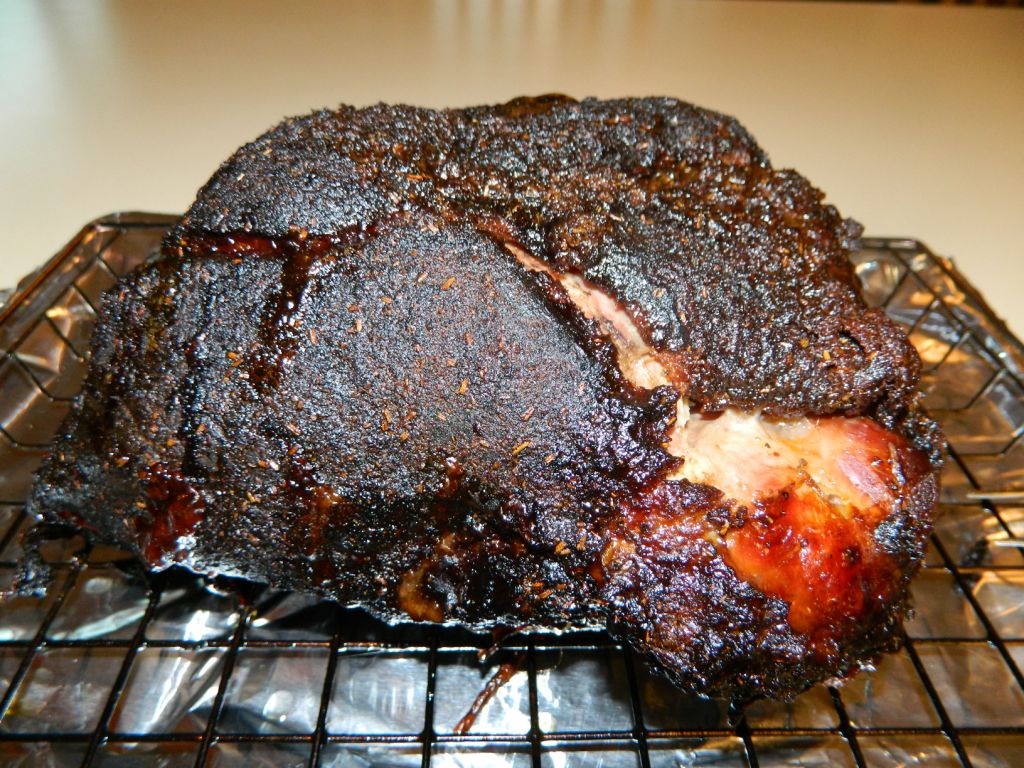
That dark crust on the outside is the best part. It's called the bark and is the hallmark of smoked meat. It's chewy, intensely flavored heaven, let me tell you! I love, love LOVE it!

The pork shoulder was juicy and falling-apart tender, just as it should be. All it took was some gentle shredding with two forks...


I resisted the extremely strong urge to keep all of the bark pieces for myself and mixed them in with the rest of the meat. It really kicks up the flavor. That didn't stop me from helping myself to some of the especially yummy-looking bits as I was shredding it, though. It's the cook's prerogative! That's my story and I'm sticking to it!

G.W. and I didn't even bother to get sandwich buns. We just piled the pulled pork into bowls, topped it with some of my secret recipe homemade BBQ sauce and stuffed our faces. I love being a carnivore!

This summer, I'm thinking I should find a BBQ contest and try my luck with this recipe! 

My next smoker project will be a brisket. Any Texans out there have some recipe suggestions?


Tuesday, January 29, 2013

Smoked and Cured Salmon - The Taste Test

Although it's long over-due, here's the second part of my post on smoked and cured salmon.  

After two days of cold curing, the gravlax was ready to eat.  I took both the gravlax and the smoked salmon into the office where I work. My coworkers graciously agreed to be my guinea pigs!  One person brought the bagels and coffee; another brought the cream cheese.


The smoked salmon had a flaky texture very similar to poached or baked salmon. The gravlax had a softer texture and did not flake. It needed to be sliced very thinly. (Just as it should be.)


The flavors were superb, if I do say so myself. The gravlax tasted very much like what I've bought in stores. The smoked salmon had turned out just as I expected...pronounced smoke flavor balanced nicely with the flavors from the spices in the rub.

My coworkers surprised me because there wasn't a clear favorite. They liked both varieties equally!  And ate both in quantity!  Personally, I preferred the gravlax but only because I've always liked cold cured salmon better than smoked.

I'm still amazed at how simple it is to make both of these. No more store-bought gravlax for me!  Try it yourself and see...there's no going back once you've had homemade!

Sunday, January 13, 2013

Cured and Smoked Salmon

I have champagne tastes and a beer budget when it comes to food. I really, really enjoy smoked salmon and gravlax, but the prices can be exorbitant.  So these are treats I enjoy only on special occasion.

The other day, when the weekly sales circular for Sprout's Market arrived, I noticed that sockeye salmon was on special. That got me thinking about how hard it might be to make my own gravlax. And since we recently were gifted with a smoker, smoked salmon, too.

One of my favorite food and recipe websites is Cooking for Engineers. Their tag line is, "Have an analytical mind? Like to cook? This is the site to read!" It's a wonderfully quirky site that melds science and cooking.  

The site had a recipe for gravlax which looked so easy I was skeptical. All it takes is a piece of salmon, some kosher salt, sugar, black pepper, dill and a little bit of time. Interestingly, it takes virtually the same ingredients for hot smoked salmon.

The recipe for smoked salmon comes from the recipe booklet that was included with the Bradley smoker. (See the January 6, 2013 post for details on the smoker I'm using.)

Before you dive right in and buy a big ol' slab of salmon from the market, you need to understand that certain parasites like roundworms can live in salmon. Cooking salmon will kill them. But if you are curing them for gravlax, there's no application of high heat to kill the parasites. The way to ensure that you have safe salmon for gravlax is to either buy previously frozen salmon or freeze it yourself first. You must freeze it at 10 degrees below zero for a minimum of a week. Please take the time to educate yourself on safe processes before you attempt this (or any recipe) that you find here at Crossed Sabers.

The salmon I got was previously commercially frozen, so it is now completely safe.

First, you cure the salmon. The cure ingredients for 1 1/2 pounds of salmon are 3 Tbsp kosher salt, 3 Tbsp white sugar and 3 tsp. ground black pepper. You also need fresh dill. The same cure works for both the gravlax and the smoked salmon. The only difference in preparation is that the salmon for smoking gets a rub down with some vegetable oil before the cure is applied.

Both get wrapped in several layers of plastic wrap. 


Put them into a dish with sides because the cure will draw out liquid from the salmon. Then refrigerate.

The salmon for smoking needs to cure for 14-20 hours. The salmon for gravlax needs two to three days.

Here's the one for smoking after 20 hours. You can see how much liquid has come out. The texture of the fish is much firmer than when I put it in the cure.


Remove the dill and rinse off the cure. Pat the flesh side dry with paper towels.


I preheated the smoker to 100 degrees and dropped some Bradley's "Special Blend" Bisquettes into the smoker's hopper.
  

Of course the day I pick to do this little project brings nasty weather. It's 9 degrees and snowing hard. Ugh! I've got the smoker on the patio under the deck. It's only slightly sheltered from the weather. Good thing the Bradley doesn't need lots of attention and fussing! 

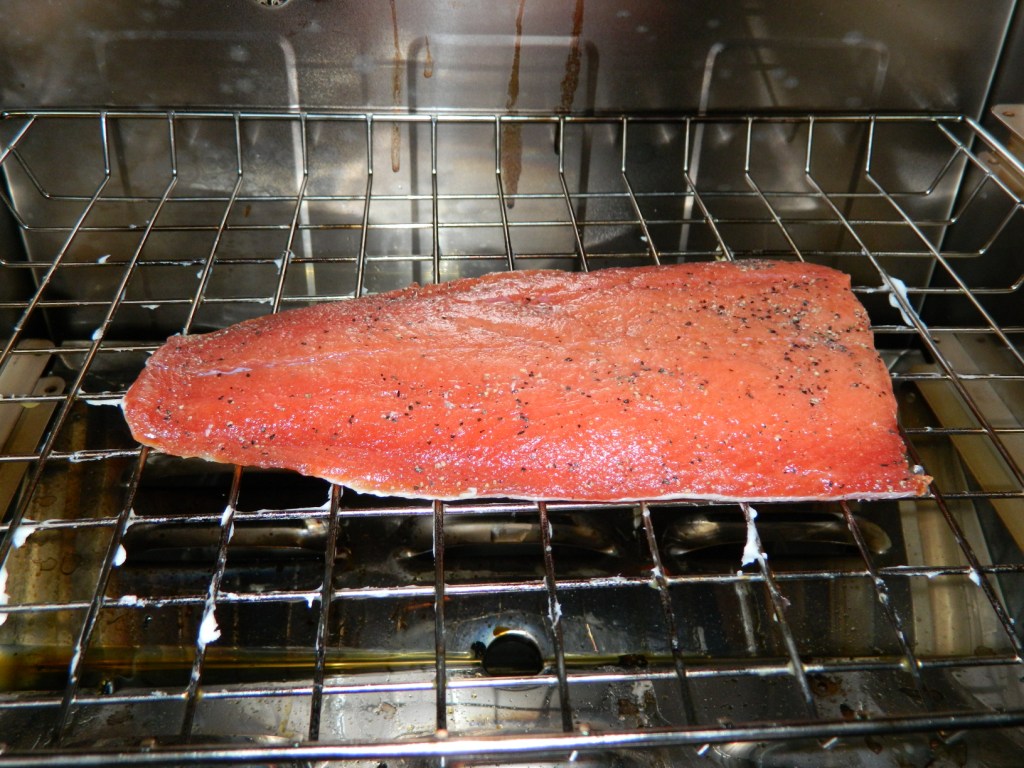
Grease the smoker rack, put the salmon in skin-side down and let it go for one hour at 100 degrees. 

Then, according to the recipe, raise the temperature to 140 degrees for one hour, then 175 degrees for one hour.

Here's what it looked like right out of the smoker. It's cooked all the way through, but the thin ends look dried out. 


I flaked off a little bit to taste and it was pretty good. Yes, it's just a tad on the dry side, unfortunately. It had a smoky flavor that wasn't unpleasant, but a little strong. My experiment with smoked salmon wasn't a huge success, but it wasn't a flop either...it IS edible! I'm kicking myself for not remembering to buy some bagels.

Here's what I learned from the experiment:
1) Smoking fish is easy.
2) Trim the pieces of fish before they go into the smoker so that they are of even thickness. (No dried out ends!)
3) Experiment with different woods for smoking to see if a more subtle, complex flavor is possible.


Let's not forget about the gravlax, which still needs time to cure.  Look for the follow-up post in 2 days!


Sunday, January 6, 2013

Where there's smoke...

...there's baby back ribs!

My brother-in-law, Drew, who is an experienced hunter, gave G.W. a most excellent Christmas present this year. A Bradley Smoker. It's a pretty nifty deal that's about as foolproof as you can get. Drew got us the smoker so that we can add another dimension to cooking game. Think smoked pheasant or elk sausage!


The smoker uses these 'bisquettes" and automatically feeds them into the burner for continual smoke with hardly any babysitting or fussing. Each bisquette is good for 20 minutes of smoke. Very, very slick.


We unpacked and assembled it today.  It was ready to roll in less than 10 minutes.Talk about easy! 


In order to get rid of any weird chemical smell from the new components, it's recommended that you season the smoker for an hour before using it for food. We loaded in some bisquettes, fired 'er up and let her go.

Here's how the bisquetts feed automatically. The one on the right is on the burner.


After 30 minutes, the heat was up over 160 degrees. The recommendation is to keep the temperature at 150 for the seasoning period, so I backed the heat down just a bit.


Once the hour was up, it was time for the test run. I chose baby back ribs for the maiden voyage. 

The little recipe booklet that came with the smoker recommends pre-cooking the ribs in the oven at 350 degrees for one hour. They cooked during the hour I had to wait for the new smoker to season.  I used a purchased rub from Cabela's...their "All-purpose" rub.

Once the ribs were done in the oven, I brushed them with some BBQ sauce, then popped them into the smoker. I used hickory bisquettes.


Then every 30 minutes, I spritzed them with some apple cider vinegar and brushed on some more BBQ sauce.


I also put some baked beans into a cast iron pan and stuck them into the smoker. They went in under the rack with the ribs so that anything that dripped off the ribs would go into the beans.

Since there was still some room, I tossed a couple of fresh jalapenos onto the rack. Why not, right?

After 2 1/2 hours in the smoker, we pulled the ribs out. They looked beautiful!


While they weren't falling off the bone, they were tender, juicy and had an amazing smoke flavor. Not bad for a first attempt! The beans, which were straight out of a can, also had a nice smokey flavor.


The jalapenos should have had more time in the smoke, but I'll use them as is in beef chili.


Next time, I think I'll smoke the ribs longer and baste/spritz more often. G.W. said he's willing to "take one for the team" and be my taste tester. What a guy, huh?


My next smoking project is salmon, trout and chicken. Stay tuned for the results!